I think my favorite thing about Kim Possible is how weirdly mundane it is, for being an action show. Like most other teen superhero shows are very dramatic with huge stakes, but Kim didn’t even have any powers. She was just an exceptionally good cheerleader, she didn’t even have a secret identity. The villain wasn’t even some big baddie with a tragic backstory and weird powers, he was just some crazy middle aged dude with a grumpy assistant that like just happened to live in the same town as Kim.
They ate fast food in like every episode. What even was Kim Possible.
Don’t forget that:
Both her parents bent the dumb and unknowing parent tropes by both being geniuses and fully aware of their daughter’s superhero activities
The show also balanced funny and non-serious villains with regular actual big threat villains
Character development actually stuck past one shot episodes
Both Ron and Kim had relatable teen issues and they didn’t just give them to Kim, like Ron’s entire episode about toxic masculinity and male body image
The relatable and healthy family dynamics both Ron and Kim had with their families
Teacher’s who didn’t excuse Kim for her superhero extracurricular activities and forcing her to go through detention or pay library fines or take tests even when she just saved the world
The global spread of their adventures beyond being strictly in the USA and the respectful way Kim adapted to every culture she went to
The respectful way Kim met dignitaries and those giving her lifts everywhere
The vast allies Kim gains through the series through just her attitude and kindness alone
Their sidekick animal was a FREAKING MOLE RAT
Drakkon and Shego’s relationship was villain goals and I firmly believed set up Agent P and Doof’s relationship dynamic in Phineas and Ferb
How incredibly wholesome and inspiring he show was and how it was the animated Buffy the Vampire Slayer of our time
How Kim didn’t sacrifice traditional feminine behavior or interests or her kindness and compassion to be more macho or tough
Ron and Kim were our first shipping experience and than became relationship goals
Kim Possible is an iconic piece of 90’s television that has literally shaped an entire generation and if you don’t believe agree with me I feel so sorry for you
Also want to bring honorary mention to Ron and his family being unashamedly Jewish and them not shying away from that fact in many episodes.
This weekend I was schmoozing at an event when some guy asked me what kind of history I study. I said “I’m currently researching the role of gender in Jewish emigration out of the Third Reich,” and he replied “oh you just threw gender in there for fun, huh?” and shot me what he clearly thought to be a charming smile.
The reality is that most of our understandings of history revolve around what men were doing. But by paying attention to the other half of humanity our understanding of history can be radically altered.
For example, with Jewish emigration out of the Third Reich it is just kind of assumed that it was a decision made by a man, and the rest of his family just followed him out of danger. But that is completely inaccurate. Women, constrained to the private social sphere to varying extents, were the first to notice the rise in social anti-Semitism in the beginning of Hitler’s rule. They were the ones to notice their friends pulling away and their social networks coming apart. They were the first to sense the danger.
German Jewish men tended to work in industries which were historically heavily Jewish, thus keeping them from directly experiencing this “social death.” These women would warn their husbands and urge them to begin the emigration process, and often their husbands would overlook or undervalue their concerns (“you’re just being hysterical” etc). After the Nuremberg Laws were passed, and after even more so after Kristallnacht, it fell to women to free their husbands from concentration camps, to run businesses, and to wade through the emigration process.
The fact that the Nazis initially focused their efforts on Jewish men meant that it fell to Jewish women to take charge of the family and plan their escape. In one case, a woman had her husband freed from a camp (to do so, she had to present emigration papers which were not easy to procure), and casually informed him that she had arranged their transport to Shanghai. Her husband—so traumatized from the camp—made no argument. Just by looking at what women were doing, our understanding of this era of Jewish history is changed.
I have read an article arguing that the Renaissance only existed for men, and that women did not undergo this cultural change. The writings of female loyalists in the American Revolutionary period add much needed nuance to our understanding of this period. The character of Jewish liberalism in the first half of the twentieth century is a direct result of the education and socialization of Jewish women. I can give you more examples, but I think you get the point.
So, you wanna understand history? Then you gotta remember the ladies (and not just the privileged ones).
Holy fuck. I was raised Jewish— with female Rabbis, even!— and I did not hear about any of this. Gender studies are important.
“so you just threw gender in there for fun” ffs i hope you poured his drink down his pants
I actually studied this in one of my classes last semester. It was beyond fascinating.
There was one woman who begged her husband for months to leave Germany. When he refused to listen to her, she refused to get into bed with him at night, instead kneeling down in front of him and begging him to listen to her, or if he wouldn’t listen to her, to at least tell her who he would listen to. He gave her the name of a close, trusted male friend. She went and found that friend, convinced him of the need to get the hell out of Europe, and then brought him home. Thankfully, her husband finally saw sense and moved their family to Palestine.
Another woman had a bit more control over her own situation (she was a lawyer). She had read Mein Kampf when it was first published and saw the writing on the wall. She asked her husband to leave Europe, but he didn’t want to leave his (very good) job and told her that he had faith in his countrymen not to allow an evil man to have his way. She sent their children to a boarding school in England, but stayed in Germany by her husband’s side. Once it was clear that if they stayed in Germany they were going to die, he fled to France but was quickly captured and killed. His wife, however, joined the French Resistance and was active for over a year before being captured and sent to Auschwitz.
(This is probably my favorite of these stories) The third story is about a young woman who saved her fiance and his father after Kristallnacht. She was at home when the soldiers came, but her fiance was working late in his shop. Worried for him, she snuck out (in the middle of all the chaos) to make sure he was alright. She found him cowering (quite understandably) in the back of his shop and then dragged him out, hoping to escape the violence. Unfortunately, they were stopped and he, along with hundreds of other men, was taken to a concentration camp. She was eventually told that she would have to go to the camp in person to free him, and so she did. Unfortunately, the only way she could get there was on a bus that was filled with SS men; she spent the entire trip smiling and flirting with them so that they would never suspect that she wasn’t supposed to be there. When she got to the camp, she convinced whoever was in charge to release her fiance. She then took him to another camp and managed to get her father-in-law to be released. Her father-in-law was a rabbi, so she grabbed a couple or witnesses and made him perform their marriage ceremony right then and there so that it would be easier for her to get her now-husband out of the country, which she did withing a few months. This woman was so bad ass that not only was her story passed around resistance circles, even the SS men told it to each other and honoured her courage.
The moral of these stories is that men tend to trust their governments to take care of them because they always have; women know that our governments will screw us over because they always have.
Another interesting tidbit is that there is sufficient evidence to suggest that Kristallnacht is a term that historians came up with after the fact, and was not what the event was actually called at the time. It’s likely that the event was actually called was (I’m sorry that I can’t remember the German word for it but it translates to) night of the feathers, because that, instead of broken glass, is the image that stuck in people’s minds because the soldiers also went into people’s homes and destroyed their bedding, throwing the feathers from pillows and blankets into the air. What does it say that in our history we have taken away the focus of the event from the more domestic, traditionally feminine, realms, and placed it in the business, traditionally masculine, realms?
Badass women and interesting commentary. Though I would argue that “Night of Broken Glass" includes both the personal and the private spheres. It was called Kristallnacht by the Nazis, which led to Jewish survivors referring to it as the November Pogrom until the term “Kristallnacht" was reclaimed, as such.
None of this runs directly counter to your fascinating commentary, though.
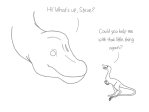
Don’t worry, guys. Carl is clearly a brachiosaurus, which lived during the Jurassic period. (And before anyone says our lil’ boy Steve is a velociraptor and therefore puts our comic in the late cretaceous, aka the time of the comet–that lil guy could easily be a compsognathus or a caudipteryx, both Jurassic-era species of small theropod dinosaurs. So the light getting bigger every night is going to pass by harmlessly, and Steve and Carl can go on enjoying the stars together until they die of old age, since Carl has very few natural predators at his size and I bet he’ll protect Steve, if he needs it (though small, fast and carnivorous as Steve is, he probably won’t).
So it’s all good!!
That entire response explaining how these two characters didn’t die a fiery death but instead lived long and happy lives literally made my day.
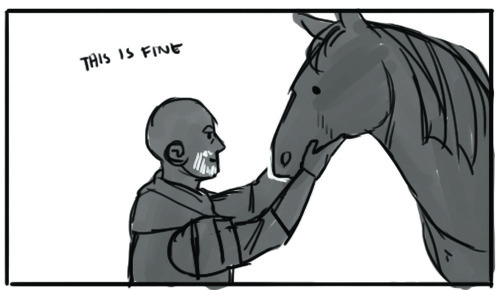
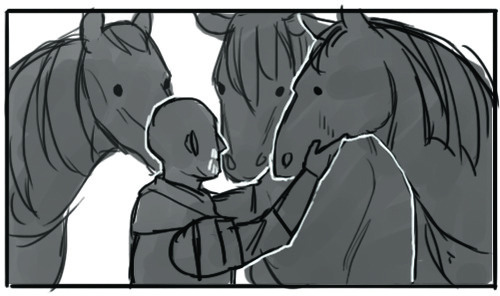
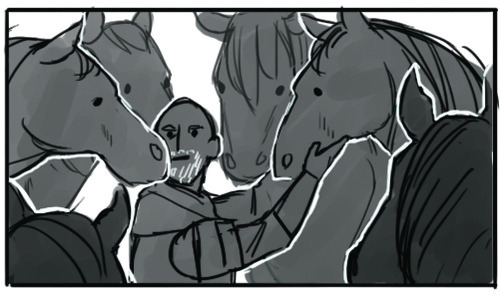
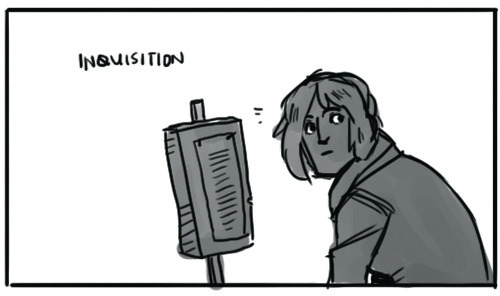
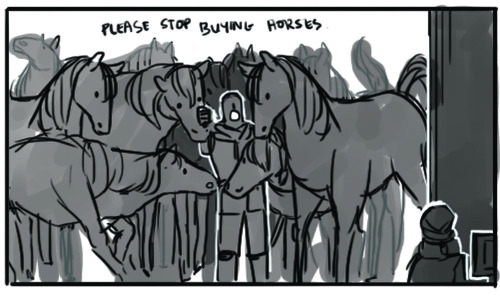
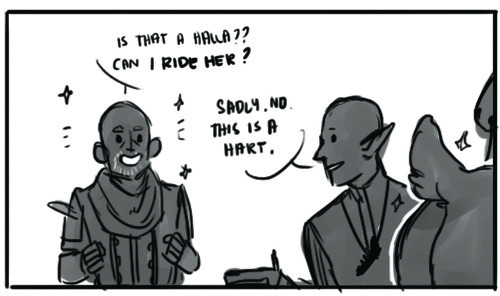
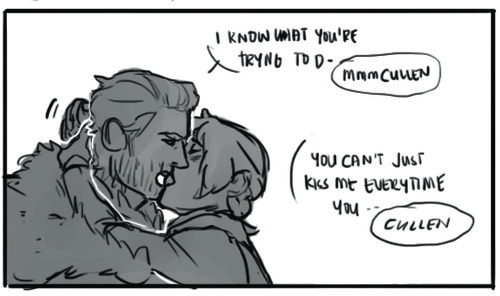
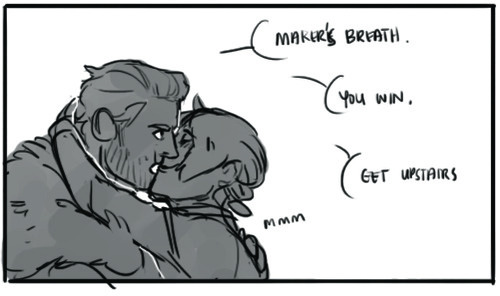
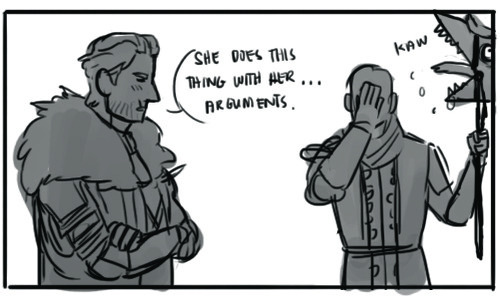
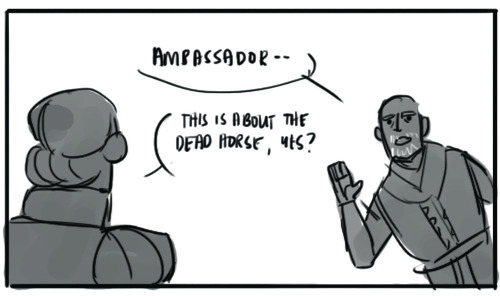
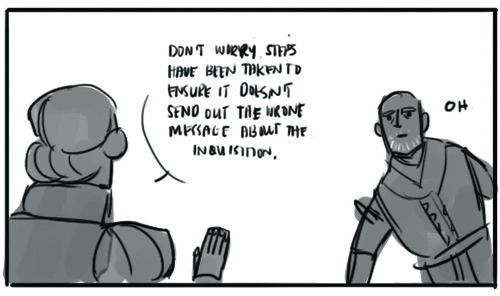
You know, I always feel a little sorry for Master Dennet. The Inquisitor is like, hey, I need a horse expert! Here is a horse expert! And he comes along to be your horse expert.
And for a while all is well. He brings his own fine horses, and the Inquisitor adds to the stable as she finds new breeding stock—often excellent. Where she got the charger from, he doesn’t know, and he feels too honored by having it in his care to ask.
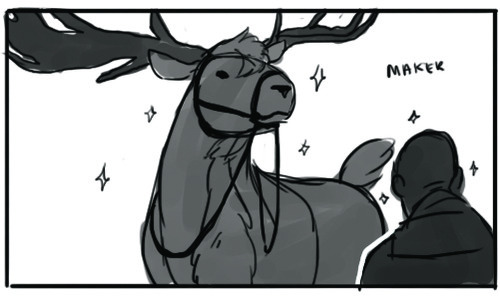
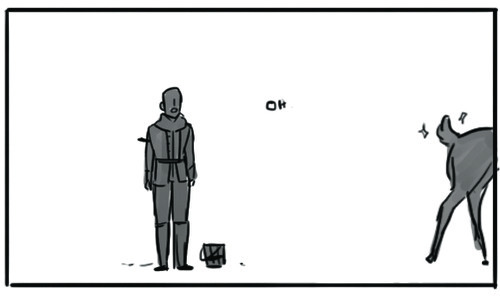
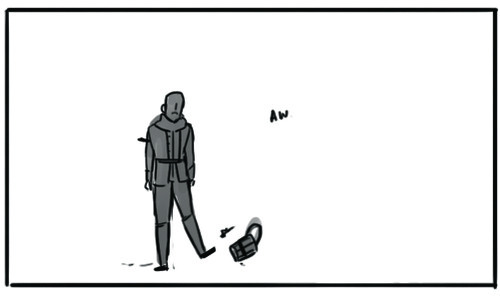
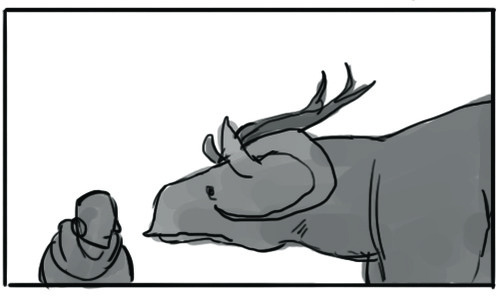
And then the Inquisitor starts coming back with like… deer. And Dennet scratches his head, because he knows horses, and just because it has four hooves and you can put a saddle on it doesn’t make it a horse. Hell, the food and space and exercise requirements for a cob and a draft horse aren’t the same—a goddamn deer is presumably completely different. But he goes around Skyhold rounding up Dalish elves until he finds one who knew something about halla, on the principle that that’s probably the closest thing, and they work it out. (He’s always respected the way Dalish treat their halla, so it’s not that big of a leap. And even though Dalish—the Charger—doesn’t know anything much about how to raise halla, he looks the other way when she wants to spend half a day in the deer’s box stall being all affectionate at it. Can’t hurt.)
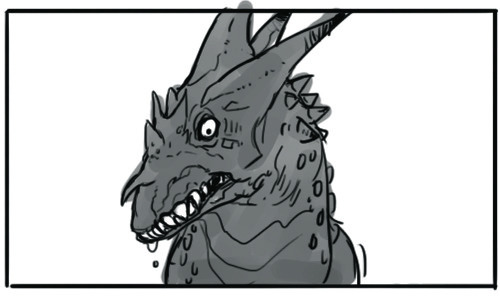
But deer of various kinds are at least still… well… grass-eating hoofed animals. Things don’t begin to really go sideways until they bring back the first dracolisk.
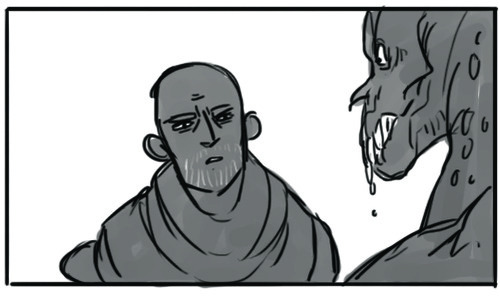
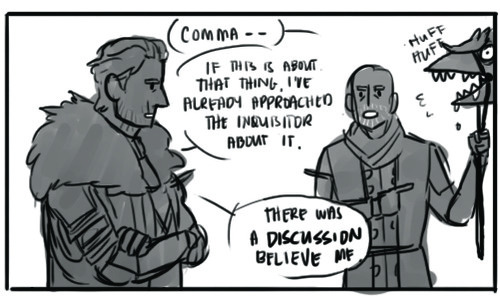
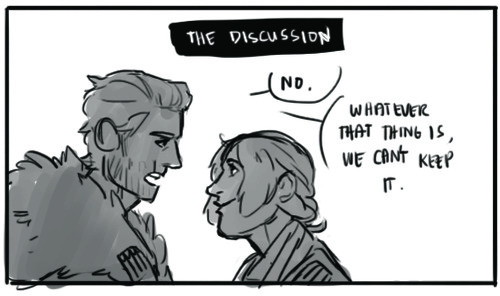
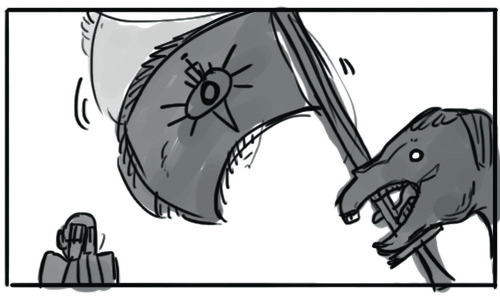
It’s a lizard. It’s a giant meat-eating lizard. Dennet is a master of horse, and he will stretch that to deer in a pinch, but asking him to figure out the care and feeding of big spiky lizard things is a bit much. It is—he tries to explain, first to Cullen and then to Josephine and finally to the Inquisitor herself—as if someone had decided that because you knew how to knead bread, you were obviously a master pugilist, because both things involved punching things. For his trouble he got a friendly clap on the shoulder and a “Just do your best! We can free up some funds to hire you more help!” (help from where? was he to hang up fliers somewhere for dracolisk handlers? where exactly was one supposed to go for that?).
(We will not even discuss the zombie horse with a sword through its head. We will not. The zombie horse got a stall to itself and was studiously ignored, on the principle that it was dead, and not much Dennet did could either help or hurt it.)
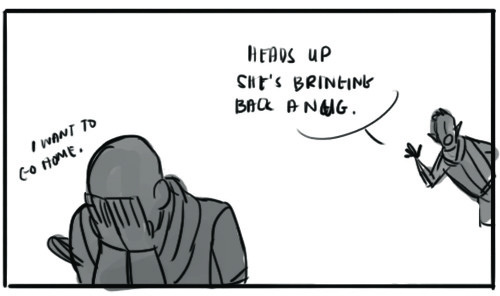
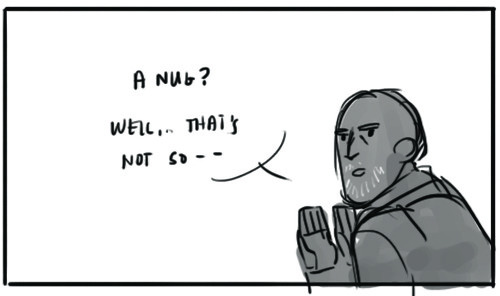
Dennet knew that he was in over his head and then some when the Inquisitor showed up with a charming grin and a giant fucking nug, and all he thought was, “Better see if any dwarves know what to feed it.” (Dagna does, but he’s a little afraid because she keeps having these ideas for ‘experimental feed,’ and….)
Sera: Eeew. You’re an elf. Hope you’re not too elfy.
Solas: Your people suck. Also, you’re wearing slave tattoos, fucktard.
Abelas: You are not my people, mongrel!
Briala: Down here with your own people for once? You stuck up, wannabe shem.
Cassandra: Why can’t you worship the Maker alongside Mythal? And everything in her temple was nonsense, by the way.
Dorian: But elves have better lives as slaves than down here. Cycles of poverty. And all that.
Blackwall: I was expecting you to be … not an elf.
Seggrit: Knife-ear – I-I mean … young lass.
Vivenne: I suppose living so far removed some society, you heathen people wouldn’t understand our ways. And your bones go clickity clackity. It’s funny.
Mother Hevarra: The Maker would send no ELF in our time of need!
Corypheus: My people called your people rats, you know.
Everyone at the ball: The Inquisitor a heathen Dalish? Never!
Ameridan: I failed to stop Hakkon, the fall of our people, and the Blight. Sorry.
Isseya: I made griffons go extinct.
Mythal: Sorry I ignored your prayers. Wait … No, I’m not.
Morrigan: Your people hunt humans for sport. I can generalize because I’m a clever witch. Also, I know more about your people and ancient elves than you, regardless of the fact that I really don’t.
Varric: Why did you drink shitty elf water?
Dalish Clan: You can’t trade with us until you prove you’re not a shem-lover.
Leliana: *kills your entire clan* Erm. Here’s a toothpick.
Cullen: *kills your entire clan* Sorry?
Josephine: *kills your entire clan* But here’s a pommel upgrade for your sword.
Lavellan: Can’t anyone in this fucking world not be a dick????






















 giipsy-dangerr's tumblr